

For Maja Chwalińska, the third week of Roland Garros has not been so very different to the first. Which is to say, there has been plenty of winning.
It was the same familiar story on Wednesday as the 24-year-old Polish qualifier battled past Anna Kalinskaya, the Russian world No 24, to reach her first major semi-final 7-6 (7-3), 6-3.
A case of same old, same old then? Hardly. Not in the wider scheme of things at any rate. Chwalińska’s best previous run at a grand slam came four years ago at Wimbledon, when she reached the second round. But in a tournament where shock results have come thick and fast, she has emerged as the queen of upsets.
Across her eight matches so far, including three in qualifying, only Maria Sakkari, the Greek former world No 3, has been able to take a set off Chwalińska. Her haul of notable scalps includes Qinwen Zheng, winner of the Olympic title on the Parisian clay two summers back, as well as Elise Mertens, the 23rd seed, and Diane Parry, the last French hope, and now Kalinskaya, a former world No 11 who knows what it is to contest a grand slam quarter-final, having done so two years ago in Melbourne.
What did Maja Chwalińska say after her French Open win over Anna Kalinskaya?
“I honestly don’t know what’s going on,” a dazed Chwalińska told Caroline Garcia as she stood smiling on Court Philippe Chatrier afterwards. “I know I repeat myself, but every single match here is kind of crazy for me, so I’m very grateful.
“I was definitely nervous, it’s normal, I care. I’m stressed, of course, but I try to focus on my job, my game. I just try to win every match that I’m playing, but I’m not focusing on confidence.
“I’m playing against the best players in the world, so I won’t compare myself to them.”
If she continues in this vein, Chwalińska may have no choice. She follows in the footsteps of her friend Iga Swiatek, a four-time champion in these parts, as just the second Pole to reach the last four at Roland Garros in the open era. Chwalińska also becomes one of only half a dozen qualifiers to make the semi-finals over that period, a feat last achieved by Argentina’s Nadia Podoroska in 2020. Not bad for a player who was struggling to fund her unexpectedly long stay in the French capital until the Polish sports drink company Oshee stepped in to help.
Early signs that Kalinskaya’s superior firepower would carry the day proved deceptive. Having hit through Chwalińska to secure a break in the opening game, the Russian slowly became enmeshed in her opponent’s intricate web of southpaw spins and all-court guile.
On a windy, overcast day in Paris, the slow conditions were grist to the mill for Chwalińska, whose combination of looping topspin forehands and viciously sidespun two-handers meant the onus was on Kalinskaya to generate her own pace. For a player who thrives on rhythm and power, it would prove an insoluble problem.
How did Maja Chwalińska disrupt Anna Kalinskaya?
Especially telling was Chwalińska’s disruptive use of the drop shot, a trademark weapon that exposed the limitations of Kalinskaya’s movement and effectiveness in the forecourt. Time and again the 27-year-old was left flailing at shoelace-level balls that left her looking ungainly and uncomfortable. Though alive to the danger – understandably so, given that Chwalińska had won 33 of the 38 drop shots she had attempted over the fortnight coming into the match – she was largely powerless to counter it.
It was not for the want of trying. Towards the end of the first set, and after being urged by her coach Patricia Tarabini to combine her natural aggression with greater patience, Kalinskaya belatedly began to find her range. Having lost five straight games, she twice broke Chwalińska as she served for the opener, fending off set points in both games. By the time she levelled at five games apiece, the qualifier’s scrambling feet had become the soundtrack to the contest, her defensive efforts becoming increasingly desperate.
Even as she threatened to falter, however, the danger posed by Chwalińska remained clear. Her craft and cunning were no less evident in the delicious lob volley winner with which she punctuated a brilliant 27-shot rally than they were on the many occasions when she snuck in mid-rally to volley away winners.
It was perhaps the enduring sense of menace posed by Chwalińska that prompted Kalinskaya to lapse into error in the tiebreak that followed. When a backhand sailed long to signal the conclusion of the opening set, Kalinskaya’s unforced error tally stood at 29 to the Pole’s 10.
Anna Kalinskaya: ‘The ball is coming at one mile an hour’
Three games into the second set, another untidy error cost the Russian a break from which she would not recover. Her mental turmoil was laid bare by the frustrated exchange with Tarabini that followed. “The ball is coming at one mile an hour and you want me to push?” barked the exasperated Kalinskaya. “That’s all you can do,” replied the Argentinian with a wan smile. By the end, it was far more than she could do.
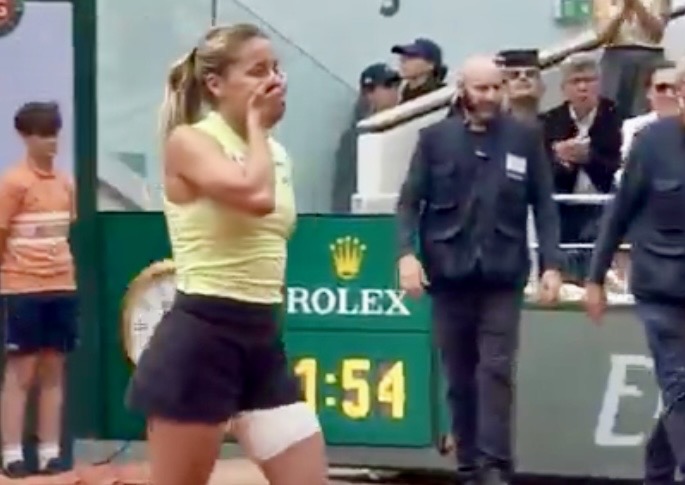
As Kalinskaya sent a final ball long, Chwalińska held her head in her hands and then walked to the net with her hand over her mouth, a portrait of disbelief.
Food, rest and Netflix await, said the Pole, who will now face the winner of the day’s second quarter-final between Aryna Sabalenka and Diana Shnaider. If she finds anything more compelling to watch than her own run to the last four, she will be doing well.