

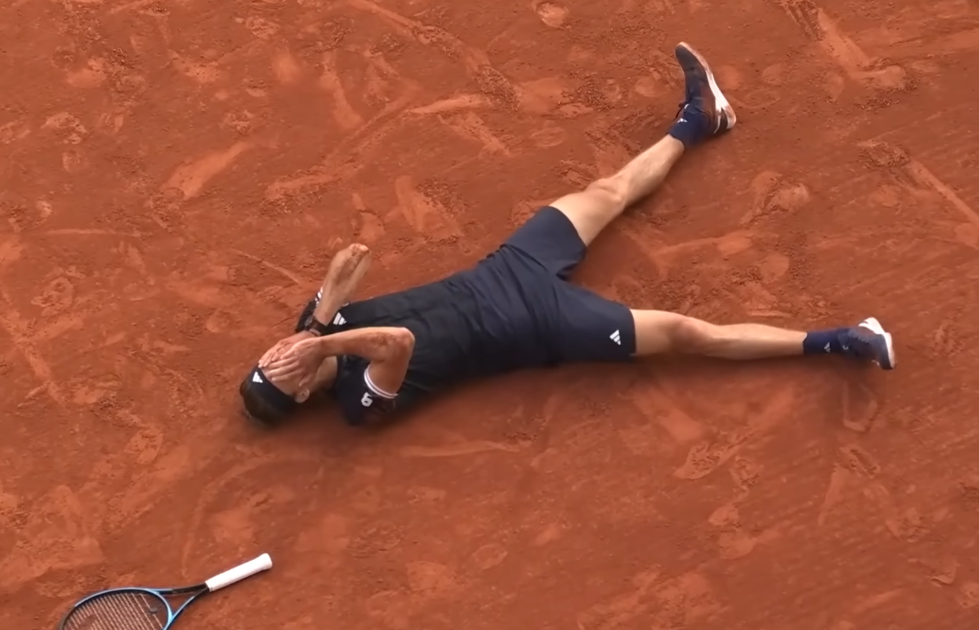
For interminable seconds, Alexander Zverev lay weeping on the clay at the north end of Court Philippe Chatrier.
In that moment, it was impossible not to recall the horrendous scenes that unfolded in the same spot in 2022, when the German was left writhing in agony after tearing his ankle ligaments against Rafael Nadal.
Happily for Zverev, this time was different: a moment of catharsis in the broadest and most literal sense. He had just done what many thought he might never do. By defeating Italy’s Flavio Cobolli in a match spanning more than four hours and five sets to win the French Open, the 29-year-old had secured his first grand slam title, at the fourth time of asking.
With his 6-1, 4-6, 6-4, 6-7 (5-7), 6-1 victory, Zverev cleansed the painful emotions associated with the injury that derailed him four years ago, and applied a salve to similarly excruciating memories of his previous grand slam final defeats against Dominic Thiem at the 2020 US Open, Carlos Alcaraz two summers ago in Paris, and Jannik Sinner last year in Melbourne. In a sporting sense, at least, the pain of those moments was eased and Zverev’s sense of self renewed.
What did Alexander Zverev say after his French Open victory?
“This court is so special to me in so many ways,” he told the French crowd. “I’ve had the best moments of my life on this court, I’ve had the worst moment of life on this court. I was laying in that corner over there, four years ago, with seven broken ligaments and two fractured bones. I lost a grand slam final here two years ago. But now, finally, it’s a happy end.”
For those who struggle to forget that Zverev has twice denied accusations of domestic abuse, the last of those sentiments will be problematic.
Two years ago, the German reached an out-of-court settlement with his former partner Brenda Patea, the mother of his child, after she claimed he had physically assaulted her. Zverev denied Patea’s claims, just as he did those of another former girlfriend, Olya Sharypova. The ATP commissioned an independent investigation into the latter case, with the inquiry concluding there was insufficient evidence to substantiate the allegations.
Alexander Zverev, Flavio Cobolli and a French Open final of uneven quality
If the identity of the new champion was not to the satisfaction of all, the same could be said of the uneven quality of the tennis on show. While Zverev’s level fluctuated, particularly as the finish line beckoned in the fourth set, Cobolli, seeded 10th and contesting his first major final, began the afternoon nervously and finished it physically compromised and far below his best.
Yet the 24-year-old showed spirit to force his way into the match after a slow start and, while he will have better days, he produced enough moments of quality to make it competitive. If it remained a far cry from the sporting banquet put on by Carlos Alcaraz and Jannik Sinner in last year’s final, neither was it a case of feast to famine. Not quite, at any rate.
After overhitting early on, Cobolli began to play with greater patience and margin in the second set. It meant that when the previously flawless Zverev faltered for the first time, throwing in a pair of double faults in the seventh game, Cobolli was well placed to take advantage. With the match all square, however, it was Zverev’s turn to dig in. Having moved within a game of restoring his lead at 5-4, he was rewarded with a flurry of forehand errors from Cobolli that left him just one set away from finally ending his grand slam drought.
It was an unmissable opportunity. The unique circumstances that conspired to elevate the second-seeded German to the status of title favourite – the withdrawal of Alcaraz, the two-time defending champion, Sinner’s shock defeat to Juan Manuel Cerúndolo in the second round, Joao Fonseca’s win over Novak Djokovic in the third – may never be repeated.
How Zverev lost his way in the fourth set of the French Open final
But that reality appeared to weigh heavily on Zverev in the fourth set, much as the leads he held against Thiem and Alcaraz in previous major finals had done. He began the set by dropping serve and, although he belatedly got back on level terms when Cobolli served for the set, the metronomic efficiency of the first and third sets was now a distant memory. With Zverev tightening, the door remained ajar.
Despite struggling on serve, a problem that dogged him throughout, Cobolli forced his way through in the ensuing tiebreak, hammering a huge forehand winner to tie the proceedings once more. “I just closed my eyes,” said Cobolli. “That sometimes helps.”
With Zverev beginning to labour physically, albeit more through pressure than any loss of condition, the momentum was clearly with the lower-ranked man going into the decider.
“I was cramping,” Zeverev admitted. “I was struggling physically a little bit, even though I don’t think the cramps were physical, I think they were mental. I was very tightened up, I was very emotional.
“I was a bit unstable also, in the fourth set. But I actually think that the cramps helped me in a way. I think that I let go, I hit my shots a bit more.”
In the event, though, that was more than Cobolli could do. Unbeknown to his opponent, the Italian was also suffering. His progress to the title round had been eased by the withdrawal of his friend and fellow countryman Matteo Arnaldi with a virus, but the pressure of the occasion seemed to outweigh the benefits of any additional rest. The decider slipped away quickly.
“I felt cramps on my calf,” said Cobolli, reflecting on the final moments of the fourth set. “I tried my best on the changeover, I took all five minutes. But my calf was gone. At the end, after the second game [of the fifth set], also my quad. I felt completely tired. My body left me on the court.”
Where do Zverev and Cobolli go from here?
While Cobolli will hope to grace such a stage again – “When you reach the first final, why not the second?” he mused – Zverev expressed optimism that, having finally shaken off the label of being one of the best players never to win a major, more such moments might lie ahead.
“Maybe my mind will just be a little bit calmer when I play a final,” he said. “If I had lost this one, the self-belief would’ve gone down a lot. Now that I’ve won it, I feel I can do it again.”