
As the tiger tattoo on her left forearm suggests, Aryna Sabalenka is the apex predator of the women’s tour. So as she arrives at Wimbledon as the top seed for the first time, it follows that the Belarusian world No 1 is untroubled by thoughts of the chasing pack.
“Knowing that there is someone chasing me or I have a target on my back right now, I love it,” she said in Paris a few weeks ago. “I take it as a challenge. Every time I go out there, I feel like, OK, let’s go. Let’s see who is ready for the pressure moments.”
Such self-belief has been evident throughout Sabalenka’s reign at the top of the rankings. Since reclaiming top spot from Iga Swiatek last October, following an eight-week run at No 1 in late 2023, the 27-year-old has been a model of consistency, winning WTA 1000 titles in Miami and Madrid and reaching the finals of the Australian Open, Indian Wells, Stuttgart and Roland Garros.
In the process, she has made a mockery of the notion that it is harder to hang on to top spot than to reach it. As Swiatek has struggled to hit the high notes with the regularity that kept her at No 1 for 125 weeks, Sabalenka has cemented her status. She goes into Wimbledon almost 4,000 ahead of second-placed Coco Gauff and, having reached the semi-finals in her past two appearances at the All England Club, a firm title favourite in the eyes of the oddsmakers.
But while Sabalenka’s setbacks have been few, they have been significant. Defeat to Madison Keys in Melbourne denied her a third straight Australian Open title, while an error-strewn loss to Gauff in Paris earlier this month leaves her still searching for a first grand slam title on a surface other than hard courts.
Events in the French capital also laid bare the mental fault-lines in Sabalenka’s game. She has made good the damage caused by her ungracious remarks in the aftermath of that match, when she blamed defeat on the windy conditions, her own poor play and Gauff’s mishits, but the emotional volatility that sparked that outburst, a quality she has worked so hard to tame, cannot be solved simply with contrite remarks and social media snippets.
“Usually after losing, I’m quite good,” said Sabalenka, who has apologised to Gauff publicly and privately, and last week performed a TikTok routine with the American after practising with her on Centre Court, apparently confirming the hatchet has been buried between the pair.
”I can accept losing, of course. I usually never struggle. It’s just this time it was super tough for me, I don’t know why. I wanted it badly and I just was upset that I couldn’t make it. This time, emotions took over me.
“But on court, in the finals or semi-finals sometimes, I can get over-emotional and I would like to improve that, I would like to stay to the same mentality I have during the tournament.
“I believe I get over-emotional at the last stages of the tournaments because I have this desire of winning. Sometimes it gets over me and I can lose control over my emotions. I would love to control that at the last stages of the tournament.”
It is a rare chink in the armour of a player whose withering power and growing variety seem tailor-made for Wimbledon, and it points to a deeper challenge for the Belarusian. For all Sabalenka’s insistence that she is comfortable with the external pressures that go with the No 1 ranking, the tiger within has been harder to tame.
The weight of that burden was evident in her nervous start to the Australian Open final, and it surfaced again in Paris, where she became increasingly frustrated by her inability to capitalise on a blistering start. At a point in her career where even her closest rivals often struggle to touch her, Sabalenka may just be her own worst enemy.
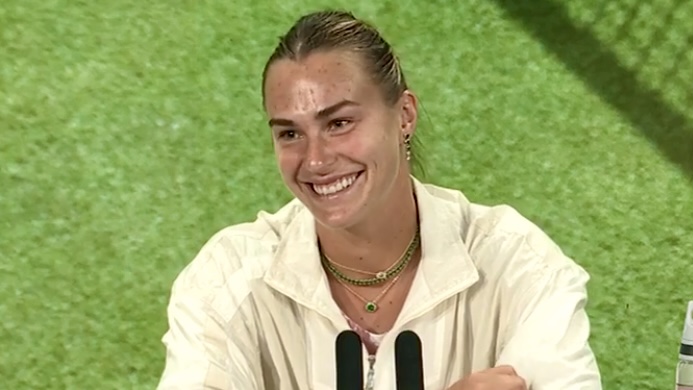
The irony is glaringly apparent – even to the Belarusian, who has acknowledged the disparity between her on- and off-court persona. Always a bubbly presence when not in the heat of battle, Sabalenka arrived in SW19 fresh from a surprise defeat to former Wimbledon champion Marketa Vondrousova in Berlin, but with a broad smile on her face.
She has had plenty of fun since, including practices with Jannik Sinner, her male counterpart at the top of the rankings, and seven-time champion Novak Djokovic, who spent more than half an hour afterwards in deep conversation with her.
There was further merriment when Djokovic gatecrashed the final moments of Sabalenka’s pre-tournament press conference.
“What do you think about hitting with me, how do you see my level?” she enquired jokingly.
“I think you have the potential, you’re a really talented player, you have nice strokes, good technique,” Djokovic replied without missing a beat. “Can I be honest? You’re lacking intensity on the court, you don’t have enough intensity. It’s too flat.”
The Serb’s irony occasioned much laughter, yet there was also truth in his jest. For all the comic mileage to be found in casting the impassioned Sabalenka as too laid back, there is a point at which desire suffocates, where intensity spills over into something more destructive. Sabalenka has identified the problem; her ability to find a solution is likely to shape the outcome of her challenge for a first Wimbledon title.