

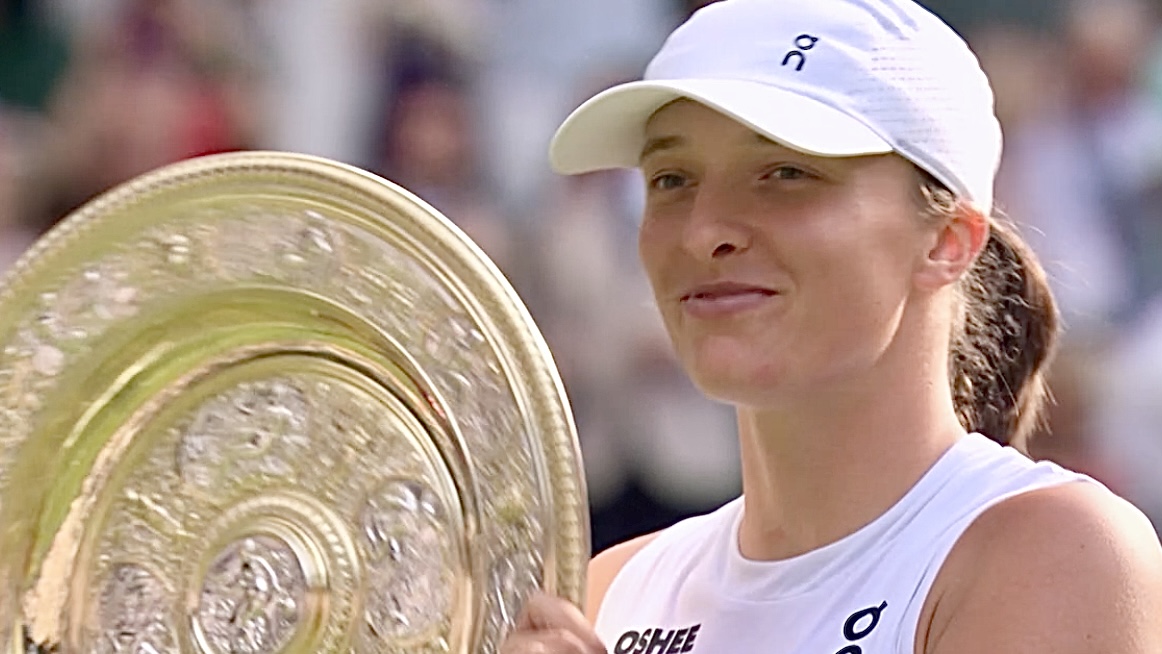
The Queen of Clay is now the Queen of Grass.
Iga Swiatek, a four-time French Open champion who has long regarded the lawns of the All England Club with deep suspicion, staged a Centre Court masterclass on Saturday to win the most one-sided Wimbledon final in more than a century.
The Polish eighth seed demolished Amanda Anisimova of the United States 6-0, 6-0 to win her first Wimbledon title, delivering a performance of such devastating authority and intensity that the whole thing was over in just 57 minutes.
Rarely has the long-running joke about Iga’s bakery – an allusion to the 24-year-old’s signature habit of doling out 6-0 and 6-1 sets, known in tennis parlance as bagels and breadsticks – felt more relevant, or more wildly inappropriate. For while the afternoon was first and foremost about the excellence of Swiatek, another abiding memory will be Anisimova’s tearful anguish at her inability to touch the heights she reached against Aryna Sabalenka in the semi-finals.
Instead, the final act of the 23-year-old Floridian’s tournament was a mirror image of the first, Anisimova forced to taste the same bitter draught she had served Yulia Putintseva in a 6-0, 6-0 opening-round win.
Anisimova was overwhelmed long before Swiatek drilled a final backhand beyond her to confirm a sixth grand slam title. She struggled to compose herself at the final changeover, and in the aftermath of defeat there were distant echoes of the late Jana Novotna’s tears after the 1993 final. Like the Duchess of Kent before her, the Princess of Wales offered words of consolation, telling her to keep her head high.
So she should, for Anisimova has been through much to reach this point. Her father Konstantin died suddenly before her 18th birthday in 2019, and two years ago she took a prolonged break from the game to look after her mental health. Anisimova broke down repeatedly as she looked up to her courtside box to thank her mother Olga – “the most selfless person I know” – for her support down the years. She lost the match, but will have won plenty of admirers.
Ultimately, though, it was a day when Swiatek etched another indelible impression in the history books. She becomes the first Polish player to win a Wimbledon singles title, and the first to win a grand slam final without conceding a game since Steffi Graf eviscerated Natasha Zvereva at Roland Garros in 1988.
The last woman to claim a Centre Court whitewash in the final was Dorothea Lambert Chambers, who defeated fellow Briton Dora Boothby to win the fifth of her seven Wimbledon titles in 1911, while no player has dropped fewer than Swiatek’s 35 games en route to the title since Martina Navratilova in 1990. She is once again rubbing shoulders with giants.
The Pole’s achievement was all the more astonishing given that she had never previously advanced beyond the quarter-finals at the All England Club, and had not won a tournament since last summer’s French Open.
“Who would have expected that?” mused Swiatek after joining Margaret Court and Monica Seles as only the third player to win each of her first six grand slam finals.
“It’s a lot, you know, especially after a season with a lot of ups and downs and a lot of expectations from the outside that I didn’t really match. Winning Wimbledon is something that is just surreal. I feel like tennis keeps surprising me, and I keep surprising myself.”
Yet it wasn’t and wasn’t a surprise.
Notwithstanding last month’s run to the final of Bad Homburg, few would have picked out Swiatek as the winner beforehand. But she built her form steadily over the course of the fortnight, growing in stature with each round after an early wobble against Caty McNally, and carried the experience of five previous grand slam victories into the final. Her familiarity with the big occasion gave Swiatek an edge every bit as significant as her tactical nous, vastly improved serving and the peerless movement that, with the help of the experienced Belgian coach Wim Fisette, she has finally adapted to the unique demands of grass-court tennis.
It was evident from the outset that Anisimova was a shadow of the devastating force that had toppled Sabalenka two days earlier. Faced by the might of the Belarusian world No 1’s huge serves and heavy groundstrokes, she had fought fire with fire; paralysed by nerves and still feeling the effects of that draining semi-final battle, she was barely able to muster a spark against Swiatek.
Anisimova is blessed with one of the finest backhands in the women’s game, yet she began by ballooning a double-hander beyond the baseline and went on to miss a trio of forehands in the face of her opponent’s bold, aggressive returning. With two minutes gone, the tone was set.
Equipped with that early break and peerless when it comes to stretching a lead, Swiatek capitalised on a flurry of backhand errors from Anisimova to consolidate her advantage, before a double fault cost the American a second break. In short space, she would become the first player to concede the first set of a women’s final without winning a game since 1983, when Martina Navratilova swept through the opener against Andrea Jaeger in equally magisterial fashion.
It was a case of double jeopardy for Anisimova. On the one hand, she had to deal with her own malfunctioning service: she landed just 45% of her first serves, winning barely a quarter of those points, and fared little behind her second delivery, with a 34% success rate. On the other, she faced an opponent who was not only dominant on serve but also constantly dragging her into the corners, forcing her off balance and denying her time to land the kind of heavy baseline blows that had done for Sabalenka.
“She came out playing very, very well, so all credit to her,” said Anisimova. “She was able to really play the game she wanted.”
The same could not be said of the misfiring American, who desperately needed to establish a foothold in the contest at the start of the second set but, repeatedly dragged deep into her forehand corner, instead committed another spate of forced and unforced errors. There would be no way back. Anisimova acknowledged she had been “a bit frozen with nerves”, but identified weariness as the greater obstacle.
“I was nervous, but it wasn’t anything out of this world,” she said. “If anything, I was more excited to go out there and compete. I think I was just really fatigued. I could feel it also in my warm-up this morning. I had to take a break after every single rally out there in my warm-up… To be able to last two weeks in a grand slam is definitely something that you need to work a lot on.”
It is a discipline long since mastered by Swiatek. After a chequered season by her own exalted standards – however absurd such a statement might seem, given her semi-final finishes at the Australian and French Opens and at big events in Qatar, Indian Wells and Madrid – the Pole has largely flown under the radar at the All England Club. For a player who arrived at the previous three editions of the tournament as the freshly crowned Roland Garros champion, world No 1 and top seed, it has been an unaccustomed luxury – although she was not about to start ranking her grand slam achievements.
“I think the fact it’s on grass, for sure it makes it more special and more unexpected, so for sure it feels like the emotions are bigger,” Swiatek admitted. “At Roland Garros, I know I can play well and I know I can show it every year.
“Here, I wasn’t sure of that and I had to prove it to myself. For sure I’m not going to rank [my grand slam wins], because I have so much respect for the other tournaments. I worked really hard to win all the other slams, so there’s no point in choosing between them.
“But this one and the US Open [in 2022] for sure feel better, because no one expected that. It wasn’t a relief, it was more just good tennis and working to make it happen.”
Like the quality of her tennis, Swiatek’s work ethic has never been in doubt. But her Wimbledon triumph was also underpinned by hitherto largely unseen qualities: versatility, adaptability, a newfound willingness to slice and block. Patience allied with timely aggression; instinct and improvisation combined with the technical and tactical preparation on which she habitually thrives. Fun, even, for she was never a mere dirtballer or “robot”, as some have uncharitably labelled her.
“Today I just wanted to enjoy the time that I had on Centre Court and enjoy the last hours of me playing well on grass, because who knows if it’s going to happen again,” said Swiatek. “I just focused on that and I really had fun.”
Swiatek served a one-month ban late last year after unwittingly consuming a contaminated dose of melatonin, costing her the chance to defend points in Japan and China and the loss of the No 1 ranking. The International Tennis Integrity Agency deemed her transgression to be at the lowest end of the range for “no significant fault or negligence”, but Swiatek was deeply affected by the episode and that has, perhaps, been reflected in her tennis.
Now the smile has returned to her face. She greeted victory with unconfined joy, falling on her back in disbelief before gambolling across Centre Court, and she celebrated exuberantly on retreating to the clubhouse balcony with the Venus Rosewater dish. Above all, her game is once more evolving. There will surely be more afternoons like this.