

Few sequels are as good as the original, and the second meeting between Jannik Sinner and Carlos Alcaraz in a grand slam final was no exception.
Five weeks after their monumental duel at Roland Garros, expectations were understandably high at the prospect of the pair going at it again with the Wimbledon title on the line. But Paris, where Alcaraz fought back from a two-set deficit, saving three championship points to prevail after five hours and 29 minutes of extraordinary theatre, was inevitably a difficult act to follow.
The encore was a relatively anticlimactic affair, high in quality but largely devoid of the tension and uncertainty that characterised the first instalment. If the French Open final was a wild rollercoaster ride, the follow-up in SW19 had a more Aristotelian quality, drama giving way to catharsis as Sinner exorcised memories of his ordeal on the Parisian clay with a clinical 4-6, 6-4, 6-4, 6-4 victory.
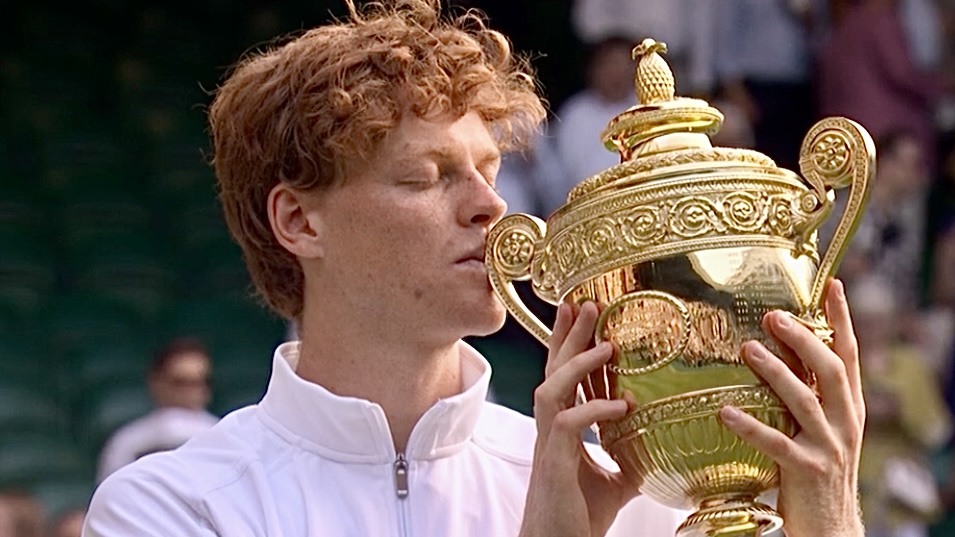
In securing his fourth grand slam title, and first away from the hard courts of Melbourne Park and Flushing Meadows, the 23-year-old ended a run of five straight defeats to Alcaraz and became the first Italian to lift a Wimbledon singles trophy. For a player who returned from a 12-week drugs suspension in early May after testing positive for a banned anabolic steroid that purportedly entered his system through a massage, it represents a remarkable turnaround.
“Very emotional, no, even if I don’t cry,” said Sinner, reflecting on the moments following victory, when he crouched low on the Centre Court grass, his head bowed as he tried to process the enormity of it all. “It feels emotional because only me and the people who are close to me know exactly what we have been through on and off the court, and it has been everything except easy.
“We’ve tried to push, you know, every practice session, even [though] I was struggling at times mentally. Maybe even more in practice sessions, because I feel like when I play the match, I can switch off and just play. I believe that this helped me a lot.
“To share this moment with my family here, my whole family here, it’s the most amazing thing that could have happened to me.”
It was nonetheless a curious match, entertaining yet strangely dissatisfying, the whole somehow less than the immaculately crafted parts. That owed much to the essentially linear nature of the contest, which was controlled by Sinner aside from an electric four-game passage in which Alcaraz rebounded from 4-2 down to win the opening set. If the momentum shifts of their French Open meeting were plotted on a graph, the pattern would have formed a zigzag, gentle at first and then ever more frenetic; here, the Italian’s first-set early blip aside, things proceeded more or less in a straight line.
That is not to deny the excellence of the ball-striking from both men, or the mental steel Sinner exhibited in wresting back control after falling behind. But for once, Alcaraz failed to keep his end of the deal, failed to find that signature spark of inspiration; for once, he waved the wand only to find the magic wanting. He entered the stage as a two-time defending champion on a 24-match winning streak, but left it with his recent aura of invincibility punctured, if not his smile.
It was a reminder that Alcaraz, who had won each of his five previous grand slam finals, is fallible after all. That he is not just a walking highlight reel. There are moments when the things he does on a tennis court appear almost otherworldly, yet rarely has he seemed more human than when he looked forlornly towards his box after being broken late in the third set, yelling in his native tongue: “He is playing much better than me.”
“At some points I didn’t know what I had to do in the match, because from the baseline I was feeling he was better than me, and I couldn’t do anything about it,” Alcaraz later explained. “I think the big key was about the second serve. He was returning really well the second serve that I was hitting.
“Thanks to that, he was in the position to attack the second ball every time. It is really difficult when you are feeling that you are just defending all the time and running from side to side.”
Alcaraz is still Alcaraz and inevitably, over the course of three hours and four minutes, he showed flashes of brilliance, not least in the latter stages of the first set. In the eighth game, he laid the foundations for a break with a combination of finesse and firepower, following up a gorgeous angled drop volley with a brutal baseline barrage, and he later showcased his peerless defensive skills to telling effect, converting his second set point with a brilliant, lunging backhand winner.
More often, though, the key moments belonged to Sinner. Serving to level the contest at a set apiece, the Italian bludgeoned a forehand down the line to bring up two set points before producing a sumptuous cross-court forehand on the dead run. Later, having engineered a break with a pair of brilliant returns that he backed up with approach shots of devastating accuracy and power, he served out the third set with dead-eyed ruthlessness.
And at the death, when Sinner found himself two sets to love up and 5-3 ahead in the fourth, a lead identical to the one he had held in Paris, he refused to buckle, refused to listen to his inner demons or countenance the notion that history might repeat itself. Not even when Alcaraz, fighting to cling on to his title, served himself out of a hole at 15-30, a success he greeted with a gladiatorial roar towards his box.
Instead, with the championship in his crosshairs, Sinner was hard as nails, his focus unwavering as he carved out a 40-0 lead before sending down one last service winner to convert his second match point and seal a first win over Alcaraz since his title run at the 2023 China Open. It was the work of a man with a granite mentality.
“Today’s match I think was a match of moments, of just who was going to step up in the big moment and make something happen,” said Darren Cahill, who coaches Sinner alongside Simone Vagnozzi. “At Roland Garros it was Carlos, and today it was Jannik.
“He came here and played with a real purpose. I think you could see from the first match he played that he wasn’t carrying any baggage from Roland Garros. That’s not easy to do. It’s easy for us to say that in words, to put it to one side. But for the player to wipe it away and be able to come here with the mentality that he had, is 100% credit to him.”
Grand slam titles are rarely won without fortune smiling favourably somewhere along the way, and for Sinner that moment came in the fourth round when Grigor Dimitrov, leading by two sets to love, was forced to retire with a pectoral injury. The Italian suffered an injury scare of his own in that match, jarring his right elbow in an early fall, and he wore a protective sleeve on his arm for the remainder of the tournament. But Sinner has become inured to adversity in recent times.
“I had a tough loss in Paris,” he said. “But it doesn’t matter how you win or you lose. You just have to understand what you did wrong and you have to accept the loss and keep working. This is why I hold this trophy here.”